Dental insurance verification pricing
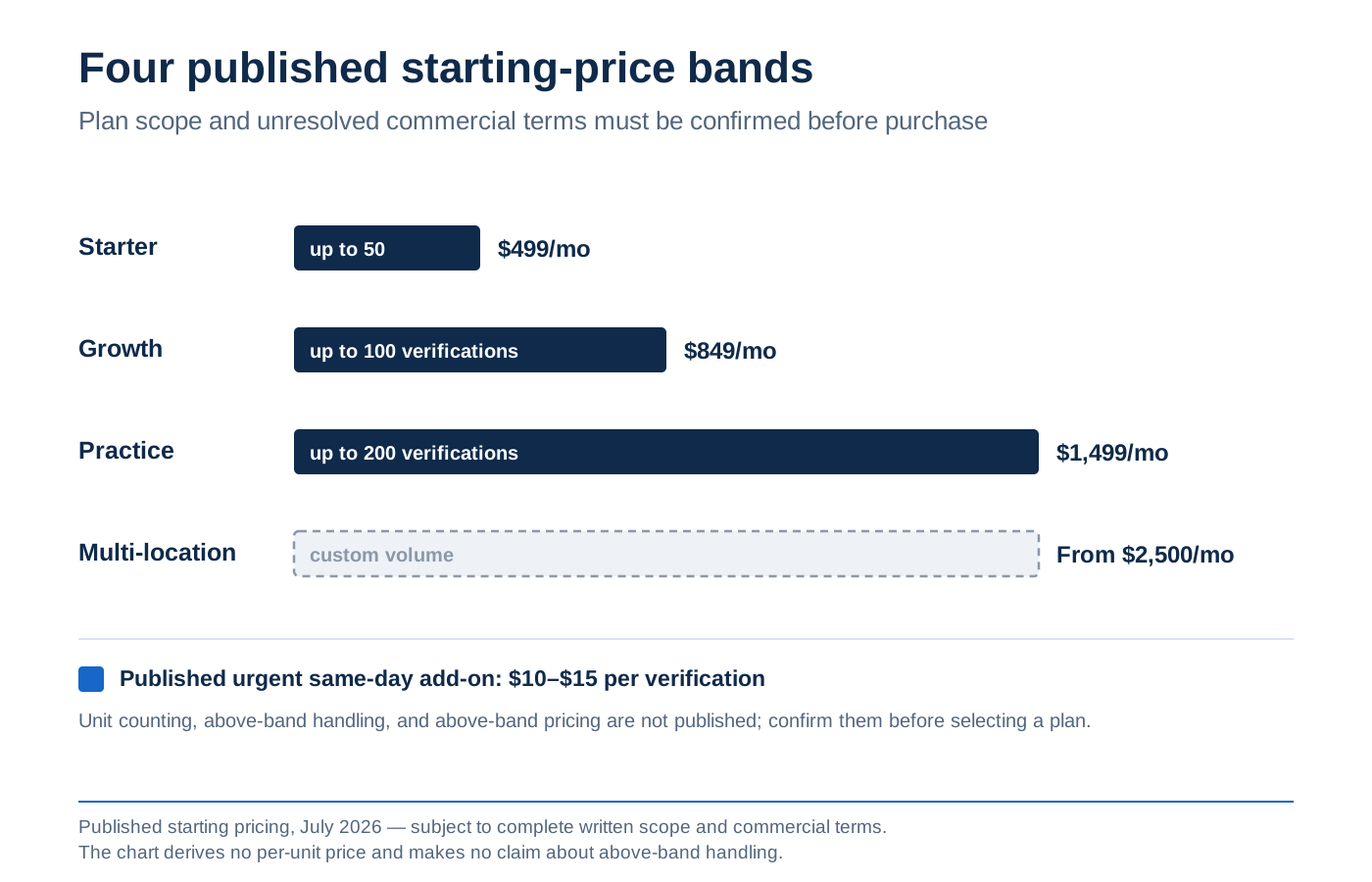
Dental Revenue Desk publishes four verification plans: $499 a month for up to 50 verifications, $849 for up to 100, $1,499 for up to 200, and from $2,500 for multi-location groups. Dental Revenue Desk separately publishes its verification service scope and an urgent same-day add-on at $10–$15 per verification. The current public record does not define inclusions for each band; require the full written scope before purchase.
Published July 21, 2026
Plans and monthly pricing
Dental Revenue Desk publishes four starting-price bands by monthly verification volume. The plan table does not define what counts as a verification, plan-by-plan inclusions, or above-band handling; those terms remain buyer-confirmation gates.
Starter
$499/mo
Up to 50 verifications
Growth
$849/mo
Up to 100 verifications
Practice
$1,499/mo
Up to 200 verifications
Multi-location
From $2,500/mo
Custom volume
Starting pricing, subject to the complete written scope and commercial terms. Dental Revenue Desk publishes these numbers instead of withholding every number until contact: why our pricing is published rather than quoted. Dental Revenue Desk prices a flat monthly band: how flat monthly, per-verification and percentage-of-collections pricing compare as a practice scales.
Published service scope and the open plan-inclusion question
Dental Revenue Desk publishes a 30-field verification service scope, owner-authorized practice-management-system write-back, an exception report, QA review, and a completion log. Those facts describe the service; they do not, by themselves, prove that every inclusion applies identically to each price band. See what a full verification covers, field by field, then the synthetic sample deliverable.
- Owner-published service promise: every scheduled insured patient
- Published 30-field benefits-breakdown scope
- Owner-authorized write-back into Dentrix, Open Dental, Eaglesoft, or the client system; mechanism and field map unpublished
- Exception report for items requiring attention
- QA review and completion log in the owner-defined workflow; exact controls and schema unpublished
- Owner-published standard target: verification completed 3–5 days before the appointment
- Plan-by-plan inclusion, unit counting, and above-band handling: not yet published
Terms that are not yet published
The public plan table states monthly volume bands, but Dental Revenue Desk has not published what counts as one verification. It does not currently state how a patient with two plans, an unresolved carrier response, or a repeat attempt is counted.
Dental Revenue Desk also has not published whether a reverification after a reschedule counts again. Those rules materially affect which band fits a practice and should be confirmed before a plan is selected.
No public term currently explains whether service continues above a band, whether work is paused, or how above-band work would be priced. Dental Revenue Desk therefore does not present the plan bands as either hard caps or automatic overage bands.
A practice comparing plans should ask for the unit definition, dual-coverage rule, exception rule, reverification rule, above-band operating rule, and any above-band price together. Until those terms are owner-approved and published, the prices above are starting prices tied only to the stated volume labels.
What to confirm before purchasing
The public prices do not settle every commercial term. Dental Revenue Desk has not published a minimum term, cancellation notice, setup fee, renewal rule, minimum-use policy, above-band rule, or end-of-engagement data terms as of July 2026. A buyer should obtain and review those terms before purchasing.
The relationship between the verification bands and the expansion-service labels — dental billing, claims management, and insurance A/R follow-up — is not published. Do not infer inclusion, exclusion, bundling, or a separate price. The owner-stated PHI boundary is separate: Dental Revenue Desk says it will sign a business associate agreement before PHI is exchanged. Retention, return, destruction, and termination provisions remain terms for legal and security review, not public promises today. See the current security disclosure.
Dental Revenue Desk has no operating history to point at, so the agreement and the published commitments are what a practice can hold it to: the owner-published target workflow and open terms set out the 3–5-day target and what remains undecided. Dental Revenue Desk publishes no cutoff or remedy for a missed window as of July 2026.
The vendor-selection half of the decision sits in two references: the questions to put to a verification vendor before you sign, and what dental insurance verification companies publish, side by side.
Urgent same-day verifications
Dental Revenue Desk publishes a standard target of completing verification 3–5 days before the appointment and an urgent same-day add-on at$10–$15 per verification for urgent same-day verification, on top of any plan.
The request cutoff, time zone, acceptance rule, capacity limit, and remedy for a missed same-day request are not published. Confirm them before relying on the add-on.
Starting with a pilot
Dental Revenue Desk’s owner offers a pilot of 10 completed verificationsonly after a signed agreement and BAA, with the BAA before any PHI access. The public source does not define the pilot inputs, system environment, access model, acceptance criteria, timing, remedies, or transition into a paid plan; the signed documents must control those terms.BAA before any access covers the full security model.
- Request a workflow review. Use the 20 minutes for practice, software, volume, and commercial questions; do not submit patient information.
- Sign the agreement and BAA. The BAA comes before any access to patient information is provisioned.
- Run the pilot only under the reviewed documents. The agreement, BAA, access design, and operating terms control the work.
- Review the evidence and commercial terms. Do not infer a production commitment or plan selection from the pilot alone.
In-house coordinator vs outsourced verification vs verification software
Common options include in-house work, an outsourced service, and software-assisted verification. The 2024 CAQH Index Report puts dental industry spending on eligibility and benefit verification at $2.1 billion for calendar year 2023, up 15 percent — the largest increase of any dental administrative task it measured, and the market Dental Revenue Desk prices against.
| In-house insurance coordinator | Outsourced verification (Dental Revenue Desk) | Verification software (the automated eligibility response) | |
|---|---|---|---|
| Who does the work | Your own employee, on your payroll, inside your practice management system | Dental Revenue Desk's verification service, with the completed breakdown written back into the practice management system; the operating mechanism is not published | The ASC X12N 270/271 transaction, answered by the carrier's system |
| Published cost basis | $23.11 median hourly wage, dental assistants (BLS OEWS 2025); $6.52 of labour per manual verification and $4.37 via a plan portal (CAQH 2024 Index) | $499, $849, and $1,499 monthly bands; Multi-location from $2,500; plus $10–$15 per urgent same-day verification | $2.53 of labour per fully electronic verification (CAQH 2024 Index), plus software and clearinghouse fees CAQH does not count |
| Time per verification | 12 minutes manual, 7 minutes by portal; manual checks range from under a minute to 29 minutes (CAQH 2024 Index) | No first-party staff-time effect has been measured or published | 4 minutes (CAQH 2024 Index) |
| What comes back | The depth depends on the practice's process, staffing, carrier access, and time available | The full benefits breakdown written back into your practice management system, with anything unresolved flagged in the exception report | Whatever the payer and product return electronically; content varies and may include eligibility and benefit data |
| When the person is out | Continuity depends on the practice's staffing and coverage arrangements | The owner describes a trained remote team working US business hours; assigned staffing, backup, and holiday coverage are not published | Availability and returned content depend on the software, connection, payer, and payer response |
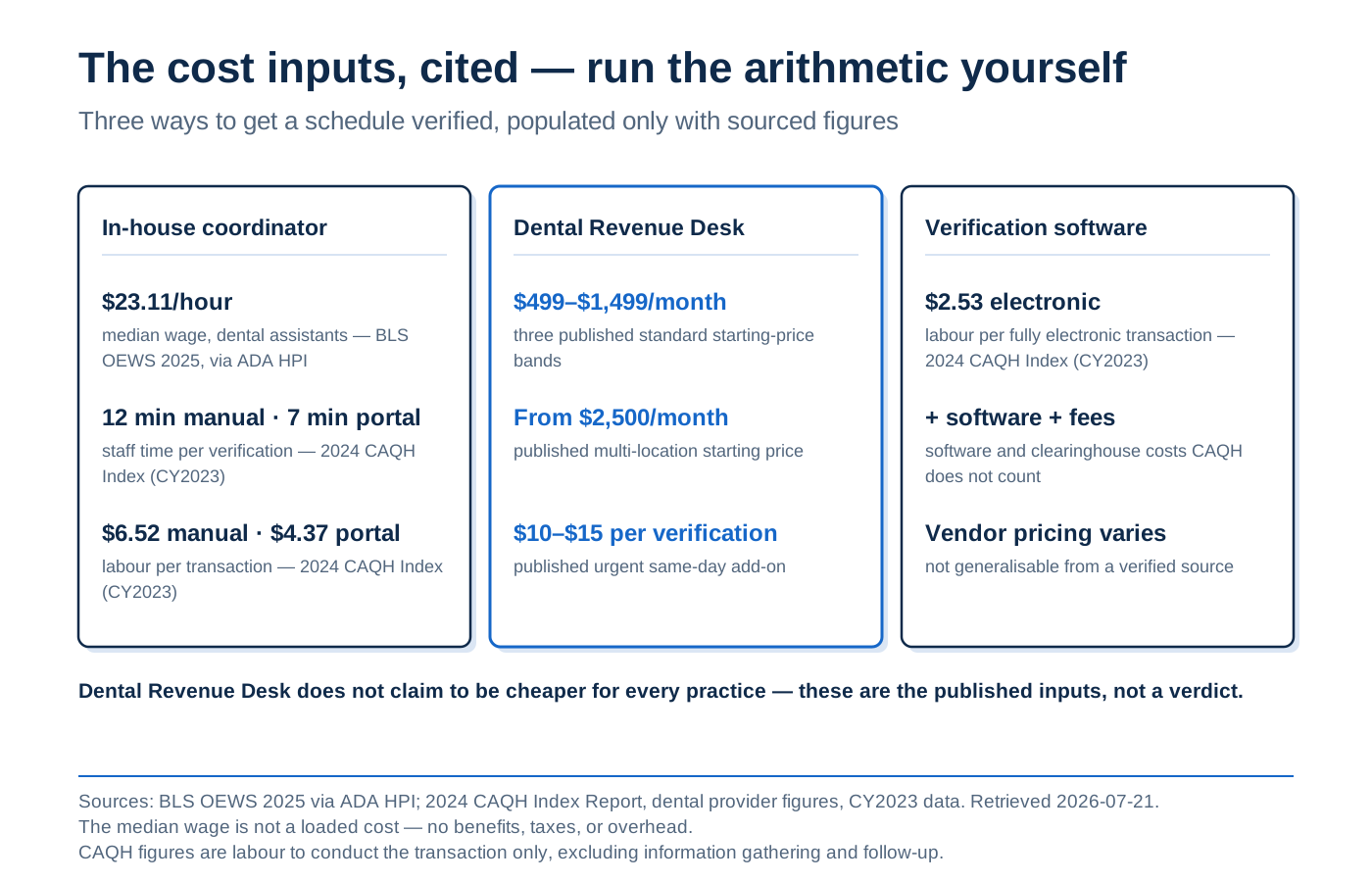
The $6.52, $4.37 and $2.53 costs and the 12, 7 and 4-minute times are dental provider figures from the 2024 CAQH Index Report, data for calendar year 2023, and CAQH measures the labour to conduct the transaction only — excluding information gathering, follow-up and system costs. They are not the cost of a full benefits breakdown, and Dental Revenue Desk does not present them as one. The $23.11 is a median hourly wage for dental assistants (BLS Occupational Employment and Wage Statistics 2025, via the ADA Health Policy Institute), not a loaded cost: no benefits, taxes or overhead.
"When it comes to eligibility and benefits, I don't have an automated tool that I can trust, so I don't use it."
What an automated eligibility response can and cannot return is documented by the practice management vendors themselves: what Dentrix, Open Dental and Eaglesoft publish about automated eligibility and write-back.
Depth matters more than a yes-or-no answer, and the only sourced evidence is hospital, not dental. In the Optum 2024 Revenue Cycle Denials Index— approximately 124 million hospital claim remits across more than 1,400 U.S. hospitals, calendar year 2023 — coordination of benefits accounts for 50 percent of registration and eligibility denials and benefit maximum for 27 percent, while raw patient eligibility accounts for 6 percent. No national dental denial benchmark exists; Dental Revenue Desk publishes none.
No verification method guarantees payment. CMS states: "An eligibility response from a health plan does not guarantee that the health plan will reimburse the provider for health services when a claim is submitted"(CMS Operating Rules FAQs, last modified 09/10/2024) — which is why Dental Revenue Desk publishes a scope, a window and a price rather than a payment guarantee.
Frequently asked questions
What does outsourced dental insurance verification cost per month?
Dental Revenue Desk publishes four starting bands: Starter at $499 per month for up to 50 verifications, Growth at $849 for up to 100, Practice at $1,499 for up to 200, and Multi-location from $2,500. Plan scope, unit counting, above-band handling, and other commercial terms require written confirmation before purchase.
What counts as one verification?
Dental Revenue Desk has not published a unit-counting rule as of July 2026. That includes how dual coverage, carrier exceptions, reverification, and rescheduled patients count. Confirm the counting basis before selecting a plan.
Is write-back an extra charge, and what happens if we go over our band?
Dental Revenue Desk publishes the full benefits breakdown, practice-management-system write-back, and exception report as its verification service scope, but the public source record does not yet establish plan-by-plan inclusion or a separate write-back charge. Urgent same-day verification is the only separately published add-on price, at $10–$15 per verification. Dental Revenue Desk has not published what happens above a plan band, an above-band price, or a minimum-use policy; confirm all of those terms before selecting a plan.
Is there a minimum term, and how do we cancel?
Dental Revenue Desk has not published a minimum term, cancellation notice period, setup fee, renewal rule, or end-of-engagement data terms as of July 2026. Ask for each term and review it before purchasing or sending PHI.
How much are urgent same-day verifications?
Dental Revenue Desk publishes a $10–$15 per-verification price for urgent same-day verification, on top of a plan. Standard service targets completion 3–5 days before the appointment. Request-handling cutoffs and any remedy for a missed target are not published as of July 2026 and should be confirmed before purchase.
Which plan fits a multi-location group?
Dental Revenue Desk publishes a Multi-location starting price of $2,500 per month with custom volume. The site has not yet published the included locations, package boundary, unit-counting rule, above-band rule, or whether scope is set per group or per site; confirm each before purchase.
Is hiring an insurance coordinator cheaper than outsourcing verification?
Dental Revenue Desk publishes three starting monthly bands at $499, $849, and $1,499, plus Multi-location from $2,500. The national median hourly wage for dental assistants is $23.11 (BLS Occupational Employment and Wage Statistics 2025, via the ADA Health Policy Institute), before benefits, taxes and overhead. Dental Revenue Desk does not claim to be cheaper for every practice; the comparison table publishes the inputs so you can run the arithmetic.
See how verification would run in your practice
A 20-minute workflow review: we map your current verification process, show you the breakdown we deliver, and confirm your software and volume. No commitment, no patient information.