Dental billing services
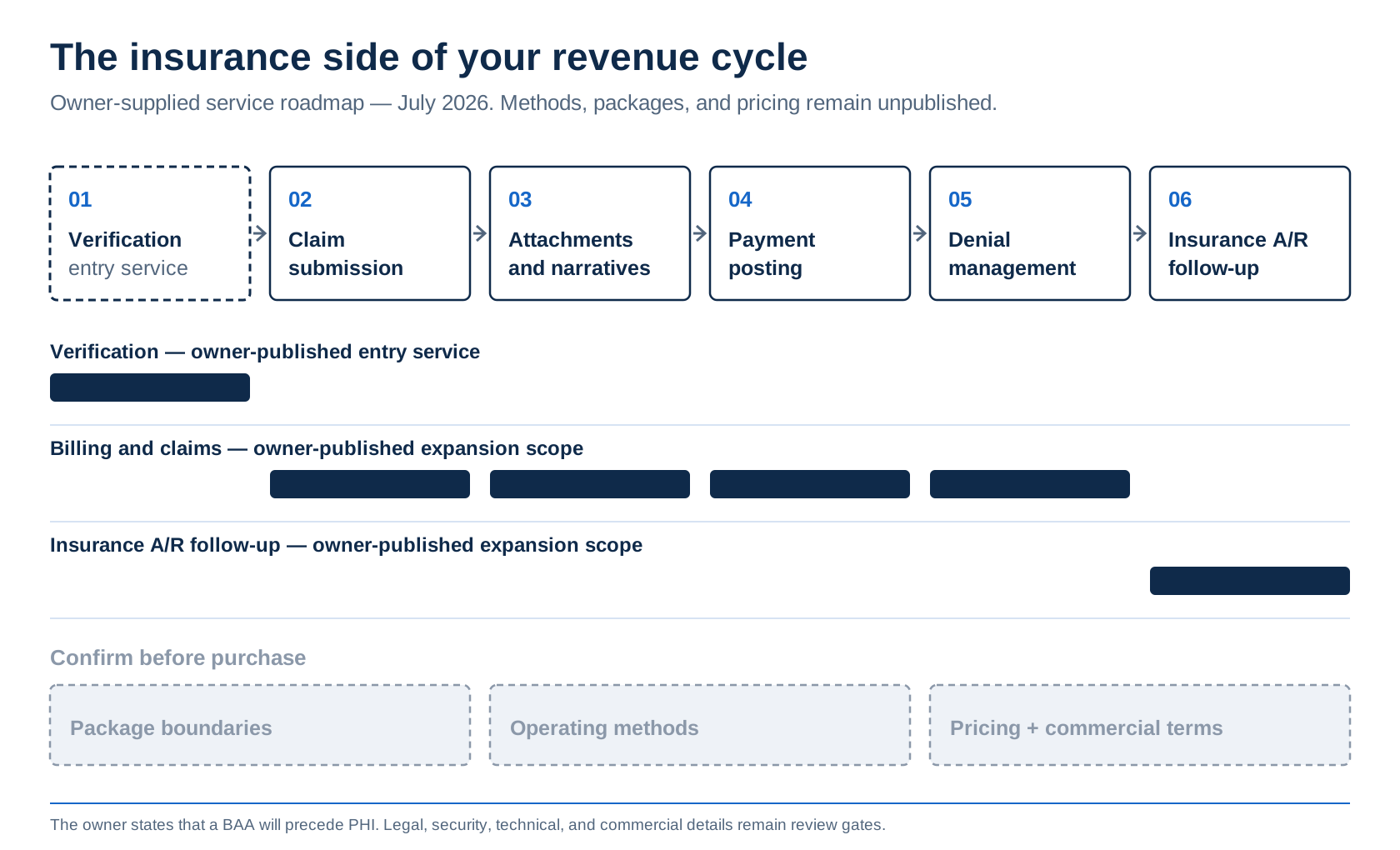
Dental Revenue Desk's owner-approved roadmap lists claim submission, claim attachments and narratives, payment posting, denial management, and insurance A/R follow-up as expansion services. The public record does not yet define whether they are sold together, how the work is performed, which systems are accessed, or what is included in a dental billing agreement.
Published July 21, 2026
Published dental billing service labels
Five billing-related functions appear in Dental Revenue Desk's owner-approved expansion roadmap. That record supports naming the functions, but it does not support a claim that all five are live, bundled into one package, performed in a particular system, or delivered through a particular access model.
Claim attachments and narratives are a distinct roadmap label. The American Dental Association reports that “Periodontal scaling and root planing (SRP) procedures (D4341 and D4342) tend to have a higher frequency for denial and/or requests for additional information from dental plans in comparison to many other procedures.” That industry context does not establish Dental Revenue Desk's attachment workflow, documentation standard, or result.
Before evaluating the service, request a written statement of work that identifies which functions are included, who owns each handoff, which systems are accessed, and what record is returned to the practice.
- Claim submission — owner-approved expansion-service label
- Claim attachments and narratives — owner-approved expansion-service label
- Payment posting — owner-approved expansion-service label
- Denial management — owner-approved expansion-service label
- Insurance A/R follow-up — owner-approved expansion-service label
Most billing problems start before the claim
A denial is usually a verification failure that surfaced three weeks late. A frequency limitation nobody checked, a waiting period nobody read, a secondary plan nobody ordered — each becomes a rejected claim, a re-submission, an aged balance, and eventually a write-off or a bill your patient did not expect.
That is why Dental Revenue Desk sells verification as its entry service rather than as a billing add-on: fixing the front end removes the work at the back end. Whether a given billing engagement includes verification is settled in your agreement.
An eligibility ping is not the same instrument: CMS states, in its Administrative Simplification operating-rule FAQs(last updated September 2024), that “An eligibility response from a health plan does not guarantee that the health plan will reimburse the provider for health services when a claim is submitted.”
The CMS statement explains why an eligibility response should not be presented as a payment guarantee. It does not prove a specific Dental Revenue Desk billing method or outcome. Review the separately published verification service, then confirm any proposed connection in writing.
Do you need billing, or just verification?
Start with the work queue you are trying to change. Pre-appointment benefit research belongs in a verification evaluation. Claim submission, claim documentation, payment posting, denial management, or insurance A/R follow-up belong in a billing-scope discussion. Dental Revenue Desk has not published a rule that one engagement must precede the other.
Signs it is a verification problem
The evaluation concerns pre-appointment insurance-benefit research: eligibility, deductibles, maximums, limitations, frequencies, waiting periods, and the practice's documented output. Review the exact published verification scope instead of inferring it from this billing page.
That is front-of-cycle work, and Dental Revenue Desk sells it separately —verification, the entry service, sold on its own.
Signs it is a billing problem
The evaluation concerns one or more post-treatment functions named in the expansion roadmap: claim submission, claim attachments and narratives, payment posting, denial management, or insurance A/R follow-up. Ask which labels are included and which party remains responsible for every excluded step.
The current evidence-boundary table identifies what is known and what still requires written confirmation.
Verification has published starting prices and volume bands. Billing does not. Do not apply the verification price table, unit definitions, inclusions, or commercial terms to a billing proposal.
Where each service starts and stops
Billing, claims and A/R are three different jobs that vendors routinely sell as one word. The table below draws the line between them, and marks plainly which terms you should get in writing before you buy — because a boundary you assumed is the one that costs you.
| Category | Published evidence | Confirm before purchase |
|---|---|---|
| Dental billing | This page groups five owner-approved expansion-service labels for evaluation. | Included functions, method, systems, handoffs, outputs, exclusions, term, and price. |
| Claims management | Claim submission, claim attachments and narratives, and denial management are approved expansion-service labels. | Whether they are bundled; status, appeal, or resubmission steps; endpoints; systems; and commercial terms. |
| A/R follow-up | Insurance A/R follow-up is an approved expansion-service label. | Eligible balances, age buckets, work method, closure criteria, reporting, exclusions, and commercial terms. |
Review the separate evidence boundaries for dental claims management and insurance A/R follow-up. The current record does not establish whether patient billing, statements, balances, collections, or other revenue-cycle work is included or excluded.
What dental revenue cycle management means on this page
“Dental revenue cycle management” is used here as a broad category, not as a promise that Dental Revenue Desk provides every activity commonly placed under that label. The owner-approved expansion record is limited to the service labels stated on this page.
The record does not publish an operating method, responsibility matrix, report, performance result, patient-balance boundary, coding boundary, credentialing boundary, or negotiation boundary. Treat each as open until it appears in a signed scope.
Dental RCM services that sell the full arc are a different shape of vendor. Dental Revenue Desk publishes verification as its entry service. The 2024 CAQH Index, reporting calendar-year 2023 data, found that eligibility and benefit verifications “are conducted the most, representing … 24 percent of the total dental volume,” and that dental industry spending on them “increased 15 percent — the highest increase among the administrative tasks measured — to $2.1 billion.”
The CAQH finding is market context for administrative transaction volume. It is not Dental Revenue Desk performance data and does not show how its billing work is delivered.
What billing costs — and why verification is priced first
Dental Revenue Desk publishes verification pricing and quotes billing to scope. That order is deliberate: billing cost depends on your claim volume, payer mix and current backlog in a way verification does not, and a flat number published before anyone has seen your A/R would be a guess wearing a price tag. Ask for it in the workflow review and you will get a written scope rather than a range.
For how the three models behave as you scale, see per-verification, flat monthly and percentage-of-collections pricing compared.
Verification pricing is different. Dental Revenue Desk publishes verification plans starting at $499 per month for up to 50 verifications; the published verification pricing table carries all four bands.
Dental Revenue Desk's owner states that a business associate agreement will be signed before PHI is exchanged. The final BAA, signing entity, billing access design, and supporting legal, security, and technical evidence remain pending review. Read the current security and Pakistan delivery disclosure.
Request a 20-minute verification workflow review and use the follow-up to ask for written billing scope and terms. The form is a follow-up request, not an automatic booking or a published quote.
Frequently asked questions
Which practice management systems do you bill in?
The public named-system promise applies to insurance-verification write-back into Dentrix, Open Dental, Eaglesoft, or the client system. Dental Revenue Desk has not published a billing-specific PMS workflow, integration, access model, or list of supported systems.
Do you sign a BAA before billing work starts?
Dental Revenue Desk’s owner states that a business associate agreement will be signed before PHI is exchanged, including for billing. The final BAA, signing entity, and supporting security evidence remain pending legal and security review.
Can you work the aging claims we already have?
Insurance A/R follow-up is an owner-approved expansion-service label. Dental Revenue Desk has not published the age buckets, workflow, package boundary, pricing, or outcome terms for that work.
What’s the difference between billing and claims management?
The owner-approved roadmap lists claim submission, attachments and narratives, payment posting, denial management, and insurance A/R follow-up. It does not establish whether those functions are bundled, sold separately, or where one engagement ends and another begins.
Do we need your verification service to use dental billing?
Dental Revenue Desk publishes insurance verification as a separate entry service. It has not published whether verification is a prerequisite for any proposed billing engagement or how the two services would exchange work.
Do you handle patient billing and statements?
The current owner-approved expansion list does not establish whether patient billing, statements, balances, or collections are included or excluded. Require the written scope and responsibility split before purchasing.
See how verification would run in your practice
A 20-minute workflow review: we map your current verification process, show you the breakdown we deliver, and confirm your software and volume. No commitment, no patient information.